The Talent Paradox: are we facing a Talent Shortage, or are we overlooking millions of Skilled Professionals?
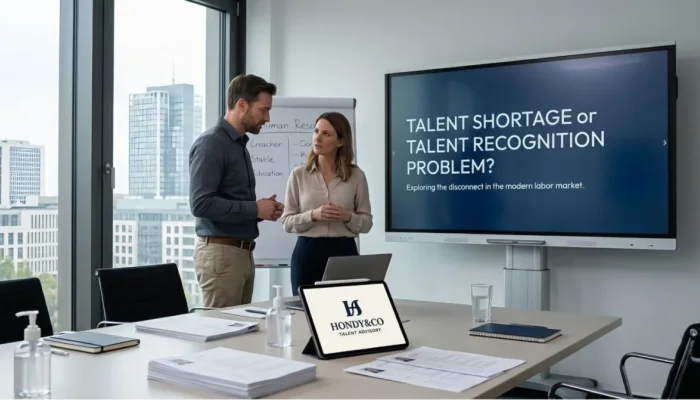
Across Europe, one message keeps coming back:
"We can't find the right talent."
From manufacturing and engineering to healthcare, logistics, construction, and technology, employers are struggling to fill critical positions. Projects are delayed, production slows, and teams are stretched to their limits.
But what if the issue isn't simply a shortage of talent?
What if we're overlooking one of the largest untapped talent pools already available?
Europe's Hidden Talent Pool
Europe is home to millions of immigrants with valuable skills, qualifications, and professional experience. Engineers, technicians, IT specialists, healthcare professionals, project managers, and skilled tradespeople are already contributing to our economies or trying to.
In 2024, nearly 43 million people living in the European Union held the citizenship of another country, including approximately 29 million non-EU citizens.
Yet far too many highly qualified professionals are unable to work at the level of their expertise.
According to Eurostat, 39.6% of non-EU citizens in the EU are over-qualified for the jobs they hold, compared with around 20% of nationals. In other words, nearly 4 in 10 skilled non-EU professionals are working below their qualifications.
Perhaps even more striking, this gap widens with experience. Professionals aged 35 to 64 are significantly more likely to be over-qualified than younger migrants, suggesting that time alone does not solve the problem. The challenge is not a lack of skills, but a lack of recognition.
The situation also varies widely across Europe. While over-qualification exceeds 60% in countries such as Greece and Italy, it falls below 30% in the Netherlands, Finland, and Sweden. This demonstrates that the problem is not inevitable. It is influenced by labour-market policies, qualification recognition, and recruitment practices.
Unemployment tells a similar story. Although employment outcomes for non-EU citizens have improved considerably over the past decade, their unemployment rate remains officially around 2.5 times higher than that of EU nationals.
Beyond the CV
Why does this happen?
The barriers are rarely about competence. More often, they include:
- Qualifications that are not immediately recognised.
- Limited local professional networks.
- Language requirements that exceed the actual needs of the role.
- Recruitment processes that favour "local experience" over transferable expertise.
- Unconscious bias during hiring.
The result is a striking paradox.
Companies report severe talent shortages, while thousands of qualified professionals remain overlooked, not because they lack the necessary skills, but because those skills are not fully recognised.
Looking Beyond Familiar Backgrounds
Too often, recruitment focuses on finding the perfect CV instead of identifying the right potential.
Consider an engineer who has successfully delivered complex industrial projects in Morocco, India, Brazil, or Nigeria. They may have managed international teams, multimillion-euro budgets, and highly technical operations.
Yet their application is rejected simply because they lack "European experience."
Talent does not become less valuable because it crossed a border.
A Business Opportunity, Not a Compromise
Europe's demographic challenges are well documented. Ageing populations and declining birth rates are shrinking the available workforce across many industries.
Addressing the skills shortage will require several complementary solutions:
- investing in education,
- developing internal talent,
- increasing workforce participation,
- embracing automation,
- and making better use of skilled international professionals who already live in Europe or are ready to relocate through legal pathways.
This is not about lowering hiring standards.
It is about widening the lens through which talent is identified.
The large differences between European countries show that this challenge is not fixed. Better recruitment practices and faster recognition of qualifications can unlock skills that already exist.
Rethinking Recruitment
The companies that will succeed in the coming years will not necessarily be those with access to the largest talent pools.
They will be those that recognise talent where others fail to see it.
Inclusive recruitment is not an act of charity.
It is a competitive advantage.
The Opportunity Ahead
Perhaps the talent shortage we keep talking about is, at least in part, a talent recognition problem.
Europe is searching for skilled professionals while millions of qualified people are already here or ready to contribute.
The next great hire may not be missing.
They may simply be overlooked.
At Hondy&Co, we've seen this reality firsthand. Some of the strongest candidates aren't the ones with the most familiar CVs. They are the ones whose potential has yet to be recognised. Our role is to help companies look beyond conventional hiring patterns and connect with talent that others often miss.
Sources: Eurostat, EU Labour Force Survey: "Migrant integration statistics: over-qualification" (2024 data, updated July 2025); "Migrant integration statistics: labour market indicators" (2025); "Migration and asylum in Europe" (2024–2025 editions).